Wednesday, 5 October 2011

Respect for Photographers


No, this is not a flexible rear wing being run by Red Bull. I was just looking through some old photos from last year and came across this reject, taken (in Hungary I think) from the pit wall.

Even with the pitlane speed limit, cars are travelling relatively quickly, and with an iPhone it's very difficult to pan accurately, and also to press the shutter at the correct time. That's my excuse anyway.

It just reminded me of the continuing outstanding quality of pictures we get from LAT, Suttons, Darren Heath and co. They do a fantastic job and even with the access they have most of us wouldn't get close to their quality.

Tuesday, 20 September 2011

So what constitutes a "Great"

(This piece was originally written for www.BadgerGP.com but I figured I may as well post it here too)

I'll admit I was intrigued by the Badgers' latest question: "Does Vettel already belong to the Greats of Formula One?"

When you're as pedantic as I am though, the first thing to do is to define what "Great" means. Is there, for example, generally at least one Great in action at any given time, or should they be ranked like eternal Olympians, and only three can ever count as being truly Great?

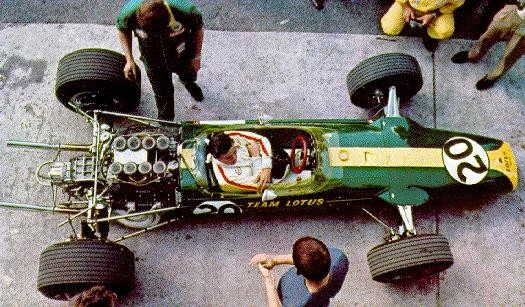
It's acknowledged that it's impossible to compare drivers from different eras on an objective basis. So here's my first pass of my own personal list of the best drivers from each of the seven F1 decades. There's no consistency as to whether a driver is listed in the decade they started or finished their career, but that's half the fun.

1950s Fangio, Moss
1960s Clark, Stewart
1970s Fittipaldi, Lauda
1980s Piquet, Prost Senna
1990s Schumacher
2000s Alonso
2010s Vettel

Note that the list doesn't include drivers that have one more than one title. Graham Hill, for example never dominated the championship, and while you could never say he was lucky, Jim Clark was clearly the man to beat in both the years when Mr Monaco (as Graham Hill was known; he is definitely a Monaco Great) won the championship.

Jack Brabham too, doesn't make the list, despite winning three championships. He simply spent too much time tinkering and building his cars and I can't imagine that Moss wouldn't have beaten him in similar equipment. Häkkinen was perhaps the hardest to leave out, but somehow, I never felt he was "better" than Schumacher - fairer yes, but not better. Ascari? A double world champion and stood on the podium in over half of the races he started. But it was that strange Formula 2 era, and I simply can't rate him as highly as Fangio. 

So then, Sebastian? Where does he rank? For me he is the Jim Clark to Webber's Graham Hill. Somehow you know he is going to be just that bit quicker and make fewer mistakes. He's already definitely in the top ten – I could leave out Alonso and either Fittipaldi or Piquet. But he's not quite ready to break into my top three yet.

And who would my top three be? In alphabetical order: Clark, Fangio, Senna and Stewart. You're thinking that's four? That's because we not only have to define "Great", we also have to define "three"! For an explanation of "Option Base Zero" see http://vb.mvps.org/hardcore/html/optionbasezero-basedarrays.htm

So who's in your top "three"?

Photo Credit: As published on http://www.jsolana.com.mx/reportaje/lotus.html

Tuesday, 30 August 2011

Paddock Club

One of the features at Marussia Virgin Racing was life at the blunt end of the pit lane. Sometimes you'd be the first pit to be reached in the pit lane, like at Silverstone, and others you'd be the last, as in Hungary. This usually depended on the position of the important facilities, such as the podium and media centre but it did also mean that quite often there was a more or less empty garage next to us, usually occupied by a group of marshals.

Nowadays, one comes to think of the Paddock Club as referring to the well-heeled guests and sponsors of the teams, receiving fantastic hospitality and exclusive access to drivers and garages in return for a four-figure sum. At MVR we were occasionally able to give away Friday tickets to lucky fans, but sadly that's the exception rather than the rule.

But I prefer to think of the volunteers that give up their time to allow any motorsport event to take place as the real Paddock Club, so here's a shot of the glamorous conditions just one storey down from its more opulent namesake. Trestle tables and cool-boxes are the name of the day, rather than linen and champagne buckets, but I suspect the guys are perfectly happy with their lot. You don't get to be a marshal at an F1 race without giving up time to go through a great deal of training, and there's usually a lot of officiating at club events (and in the UK that means putting up with very cold conditions) before moving up to the big stuff.

To all the marshals out there, thanks. Our sport couldn't function without you.

Wednesday, 24 August 2011

Time To Go Home

I know we are all looking forward to the Belgian Grand Prix, but when it's over, and especially if it's raining, spare a thought for the folk who have to put everything away. Packing starts while the race is still on, although care is taken to make sure it doesn't look like that. But that's when the trucks start to reveal their inner secrets.

Hospitality gets packed away too, so it's not uncommon to see trucks loaded with trees and bushes, or the occasional semi-surreal site of a fruit bowl co-existing with engineering equipment. Of course, the engineers and mechanics have fruit provided for them too (although the chocolate generally disappears first) but it's not displayed quite as nicely.

The motorhomes are not that easy to dismantle, although some teams have an easier job than others. You can generally reckon that the relatively simple HRT motorhome will be one of the first to be ready to drive home. Red Bull and McLaren, which require in excess of 40 trucks between them to transport the Energy Station and Communication Centre, will take a little longer.

This is the Williams motorhome, which for some inexplicable reason, starts to blast out loud rock music once it is no longer required for media functions.

Finally, there's the cars themselves. Sometimes they seem to sit around in Parc Ferme forever, before being released by the FIA. It's not uncommon to wait a couple of hours before they can be returned to the garage when they can then be cleaned, dismantled and packed for travelling.

As you can see, it starts to get dark fairly quickly, so all of the workers wear Hi-Vis to make sure that the fork lift drivers can see them, as everything still happens at F1 pace - nobody wants to stay longer than they have to!

Tuesday, 23 August 2011

Driver pics - Hungary

First of all, an apology for the quality of these pics. I probably should have taken a decent camera with me, but when you're in a working environment you kind of feel guilty about snapping pics of the stars in a quiet moment. So I never used flash, and the rooms or garages where the drivers congregate are always starkly lit, making photography from any angle tricky. That's especially true when trying to be a bit subtle, and when using an iPhone.
But still, not many people get to see drivers just before they get on the truck to do their parade lap, so I offer these as a sample. Let me know if the series is worth continuing. 

I've opted for a black and white look on these, as I love the shots from the sixties of drivers in the paddock. I always found it interesting to see who talks to whom, and in what language. You'll notice that Timo isn't in any of these pics, he was over on the left of the garage chatting, as he often does, to Jarno. Who's your favourite driver talking to?

Tuesday, 16 August 2011

DRS - 1954 style


I really liked the article in F1 Racing recently about DRS 40 years ago (Thanks for that, Jimmy, Hans et al) especially as I was around in the 60s to see the cars running with ludicrous wings - I'm especially thinking of Jo Siffert at Brands Hatch here.

At the Nürburgring, by the entrance to the paddock, Mercedes were displaying two W196 cars from 1954. One was in standard open wheel form, the other was fitted with pristine "slipstream" bodywork. This was the German company's strategy for dealing with drag on the faster circuits like Reims and Silverstone. The two cars were both beautiful, but it's the streamlined one I'd drive, given the choice.

While you can't really call it DRS, as it's not operated by the driver, it was one of the first attempts in F1 to deal with the different aero needs of various circuits. Then, as now at Monza, the main reason for this is to reduce one of the forces that are reducing the acceleration of the car - in this case: aerodynamic drag.

As drag rises with the square of velocity, at high speed circuits with long straights it's very important to minimize drag where possible.

On a more typical circuit, the exit speed of a corner is more critical at determining the amount of time spent to cover the length of a short straight, so teams focus more on increasing that exit speed by using maximum downforce.

On an infinitely long straight, you would not run any more downforce than is necessary to keep the car from lifting at speed, and the car would accelerate more quickly along the straight than if it had a High Downforce set-up.

So the question becomes - where is the crossover between focusing on corner exit speed as opposed to Vmax - maximum speed (Velocity also includes the concept of direction, but as we are talking about a straight line it's ok to use the terms interchangeably. Well, I think so!).

In this totally fictitious example, let's look at two extreme set-ups, comparing the speed of a car exiting a given corner and accelerating down a straight (all other things being equal). You can probably imagine that the Low Drag set-up will start to bring dividends if the straight is about 700m long, or longer. But if there is only one long straight at the circuit, like Shanghai, the advantage on the straight will be more than negated by the time gained by using a high downforce setting over the rest of the circuit.

Which is why it's only at circuits like Monza and Montreal that we start to hear about "low downforce" settings; although I'd really prefer to talk about "low drag", as that's what we are aiming for. We would still want to maximise corner exit speed, but not at any price. Increasing downforce increases drag with any given wing, hence the need to reduce downforce - but we'd keep it if we could.


In the 1950s and 1960s, Reims and Silverstone were both circuits consisting of long straight pieces of tarmac where the corners were defined by where the straights crossed. And Mercedes' response to this was to build special bodywork. It wasn't until the late 60s that focus switched to increasing corner exit speed.

As usual, nothing is straightforward. At Silverstone, oil drums were used to mark the edge of the circuit. But Fangio could not see exactly where they were, so on his way to winning the race, he would occasionally get too close and tap one of the drums, denting the bodywork and almost certainly reducing the aerodynamic advantage. So it goes.
Sorry, I don't know who to credit for this photo, if someone does, please tell me!
Finally, if you've got this far and are wondering what sort of biscuit to reward yourself with, go for a chocolate digestive

Thursday, 11 August 2011

Hotel Life


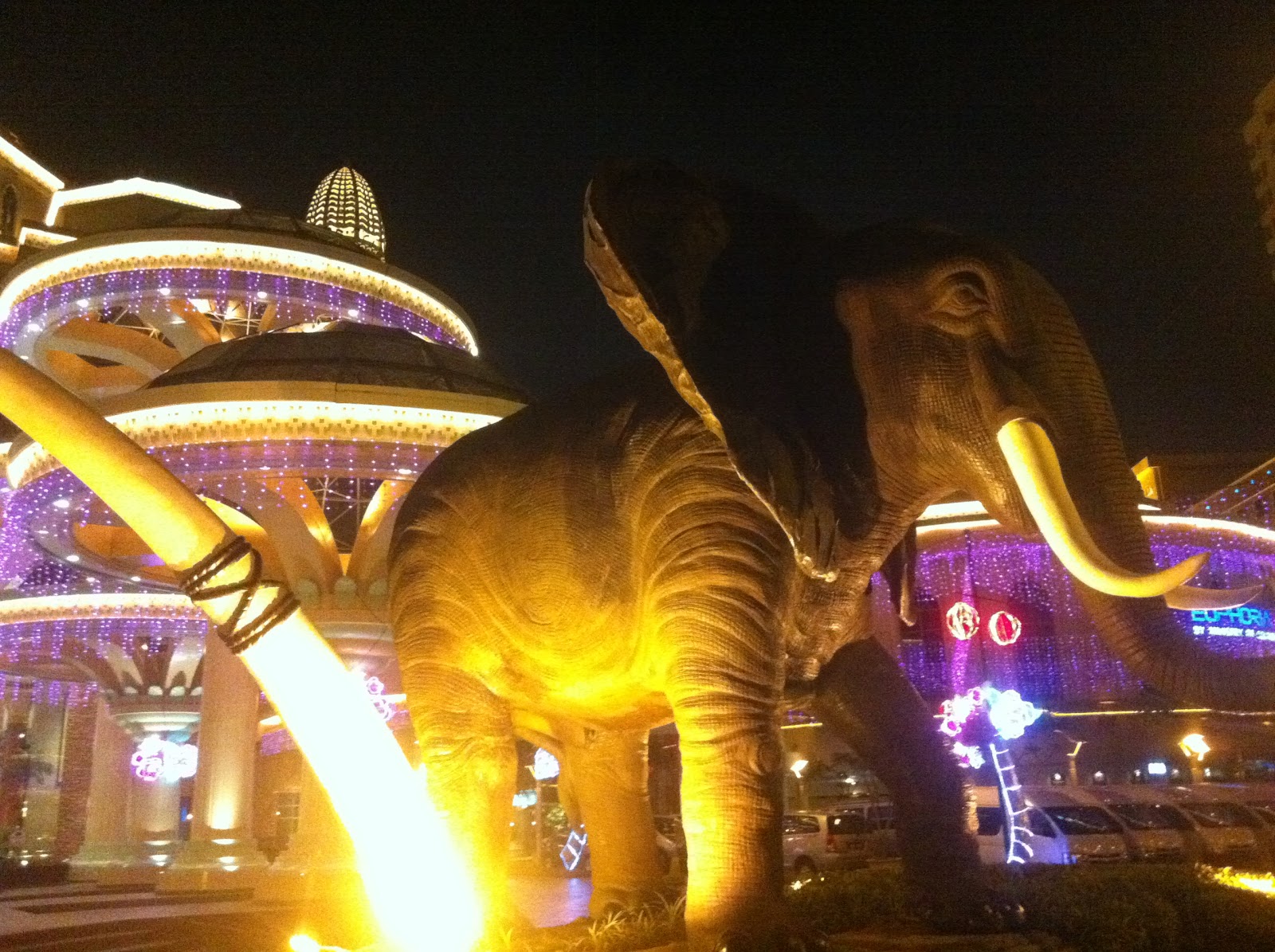
It's always interesting going to a country you've never been to before, and Malaysia certainly falls into that category. I'd been to Hong Kong, and so I was expecting to see quite a few neon lights, but I wasn't expecting the extravaganza that the hotel presented me with when I arrived at night.

First up was a full size elephant (African, judging by the ears) calmly leaving the lobby, and ignoring the Ministry of Sound club on its left. On the other hand, perhaps it was only leaving because it was offended by the tiger ripping an antelope (or whatever it is) to pieces in one of the many fountains.


But I suspect it was actually headed just round the corner, to the shopping centre that's part of the hotel complex (as is a water and "scream" park, but we'll leave that for now). After all, when a shopping centre announces its presence with an über-lifesize Sphinx, complete with eyes that light up, you know you're in for a special shopping experience. Westfield please take note.


Two days later, I was forced to follow the elephant's route when I discovered that I had only packed team trainers, and had no other shoes with me. As Saturday nights plans included a sponsor dinner near the Petronas towers, that simply wouldn't do.

Sadly, the inside of a Sphinx is very similar to a UK shopping centre. Apart, perhaps, from the ice rink. I did manage to find some nice shoes though. In fact, I'm wearing them now.