Sunday, 5 February 2012

Bruno Senna and Williams


Yesterday I was looking at a website that I used to write for, and saw that in a poll about whether Bruno Senna is the right driver for Williams this year, only 25% of respondents said yes. Admittedly, another 25% weren’t sure, which as far as I am concerned is a better answer, but 50% seem to think that they know better than the Williams team management.

They don’t phrase it like that of course, it’s probably never occurred to them. And undoubtedly people have different reasons for saying that he’s not. So let’s take a look at a few of those reasons:
  • Rubens is doing a good job and deserves another year in F1. I’m sorry, but nobody “deserves” anything in F1. If you are not doing absolutely the best job that can be done for the team, you should be replaced with someone that can do the job better. Regardless whether you are the driver, the technical director, an aero analyst or the guy that drives parts to the airport. What’s more difficult, is how you define the role of “driver”, but we’ll look at that later.
  • Bruno is a pay driver and F1 shouldn’t have pay drivers. Some of you may know my view that Bruno, Adrian, Jérôme and Co are not pay drivers, but drivers that bring a budget. A “pay driver” is someone who is there only to bring the team money, in much the same way as Brands Hatch makes money if we pay to drive one of their single seaters. Giovanni Lavaggi was a “pay driver”, Bruno et al are not. When you accept that all drivers get paid different amounts, is it actually a big step to accept that some of those amounts could conceivably be zero or negative?
  • Bruno is not likely to drive as well as Rubens. Well, Rubens has certainly had some mega drives at various stages in his career and didn’t do too badly last year but we are simply not in a position to analyse this. We know he is “experienced” and although we hear that he communicates well with engineers, maybe Bruno is even better? He apparently had extensive time in the simulator for the team to evaluate him, and looking at his performance against Petrov, after stepping in mid-season (remember Fisichella and Badoer at Ferrari) he did well in what was effectively his first F1 car
  • Someone else should have got the drive. Well, clearly not - otherwise Williams would have picked them. I’m sure they’d have loved to have kept Hulkenberg after 2010, but that wasn’t an option, for financial reasons, but I’ll cover that in a later piece.
The driver is a figurehead of a team, a key personality and undoubtedly some drivers are better than others. But they are not just slotted into a car and off you go. Every driver has strengths, and areas that are not so strong, and these areas need to be matched to the team and the car.

When a team picks a driver, they do it for reasons that are unique to that team. The financial package, much talked about in connection with Bruno, is one of those aspects, but it's far from the only one; a topic for another time perhaps? And as Williams picked Bruno, he’s right for the job. It’s as simple as that. If you don't agree, you could always start your own team.

This piece was originally posted on www.badgergp.com where I now write a weekly comment on Wednesdays

Tuesday, 20 December 2011

Odd Musings

Photo: Phil Hill at Zandvoort, 1961 copyright CahierArchive
For some reason this morning, I was looking for a picture of the old sharknose Ferrari 156 from 1961. When I saw it, I recalled that during the 1950s, most race car numbers were "even" and thus there was no talk of a race car carrying the "coveted number one". But in 1961, here was Phil Hill, with "1" proudly adorning the pointed nose.

The current system, where cars carry numbers according to the previous year's championship positions, only started in 1996; previously, the numbers 1 and 2 had been granted to the championship winning team, with the outgoing champions receiving the old numbers from that year's winners. Thus, when Williams won the championship in 1980 with Alan Jones, Ferrari received 27 and 28, which then became forever associated with Villeneuve and Alesi, the numbers staying at Maranello until 1995.

When Schumacher moved to Italy in 1996, Ferrari automatically received the number one status, but the prospect of Alesi and Berger retaining the numbers 27 and 28, but in completely different cars (they had both shifted to Benetton from Ferrari) was prevented by a shake-up of the numbering system, so that Benetton raced as 3 and 4 - numbers for which Tyrrell had been the custodian since 1974, the year after Jackie Stewart last won the championship for the team.

Photo: Rétromobile

It wasn't always so. If you'd gone to Spa Francorchamps for the 1956 Belgian Grand Prix, you'd have seen Fangio, the reigning champion (and as it's Spa, I feel obliged to slip in a "raining" pun; which, it being Spa, it was) in a Lancia-Ferrari D50 with number 2 painted on the side. His team mates, Castellotti, Frere, Collins and Pilette, carried 4, 6, 8 and 20 respectively (and here you can see why Luca di Montezemolo thinks he should be allowed to run more than two cars). Maserati, Ferrari's closest challengers, were carrying 30, 32, 34, 36 and 38 on the side of their cars in that race.

So, a question to finish: What was the first Formula 1 Grand Prix, held outside of Great Britain, to have cars with odd race numbers, and to make it just a little bit harder, let's restrict it to odd numbers lower than 50.

Answer tomorrow on Twitter. And no, I'm not counting Indianapolis as it wasn't an F1 race, it just counted towards the World Championship.

Wednesday, 5 October 2011

Respect for Photographers


No, this is not a flexible rear wing being run by Red Bull. I was just looking through some old photos from last year and came across this reject, taken (in Hungary I think) from the pit wall.

Even with the pitlane speed limit, cars are travelling relatively quickly, and with an iPhone it's very difficult to pan accurately, and also to press the shutter at the correct time. That's my excuse anyway.

It just reminded me of the continuing outstanding quality of pictures we get from LAT, Suttons, Darren Heath and co. They do a fantastic job and even with the access they have most of us wouldn't get close to their quality.

Tuesday, 20 September 2011

So what constitutes a "Great"

(This piece was originally written for www.BadgerGP.com but I figured I may as well post it here too)

I'll admit I was intrigued by the Badgers' latest question: "Does Vettel already belong to the Greats of Formula One?"

When you're as pedantic as I am though, the first thing to do is to define what "Great" means. Is there, for example, generally at least one Great in action at any given time, or should they be ranked like eternal Olympians, and only three can ever count as being truly Great?

It's acknowledged that it's impossible to compare drivers from different eras on an objective basis. So here's my first pass of my own personal list of the best drivers from each of the seven F1 decades. There's no consistency as to whether a driver is listed in the decade they started or finished their career, but that's half the fun.

1950s Fangio, Moss
1960s Clark, Stewart
1970s Fittipaldi, Lauda
1980s Piquet, Prost Senna
1990s Schumacher
2000s Alonso
2010s Vettel

Note that the list doesn't include drivers that have one more than one title. Graham Hill, for example never dominated the championship, and while you could never say he was lucky, Jim Clark was clearly the man to beat in both the years when Mr Monaco (as Graham Hill was known; he is definitely a Monaco Great) won the championship.

Jack Brabham too, doesn't make the list, despite winning three championships. He simply spent too much time tinkering and building his cars and I can't imagine that Moss wouldn't have beaten him in similar equipment. Häkkinen was perhaps the hardest to leave out, but somehow, I never felt he was "better" than Schumacher - fairer yes, but not better. Ascari? A double world champion and stood on the podium in over half of the races he started. But it was that strange Formula 2 era, and I simply can't rate him as highly as Fangio. 

So then, Sebastian? Where does he rank? For me he is the Jim Clark to Webber's Graham Hill. Somehow you know he is going to be just that bit quicker and make fewer mistakes. He's already definitely in the top ten – I could leave out Alonso and either Fittipaldi or Piquet. But he's not quite ready to break into my top three yet.

And who would my top three be? In alphabetical order: Clark, Fangio, Senna and Stewart. You're thinking that's four? That's because we not only have to define "Great", we also have to define "three"! For an explanation of "Option Base Zero" see http://vb.mvps.org/hardcore/html/optionbasezero-basedarrays.htm

So who's in your top "three"?

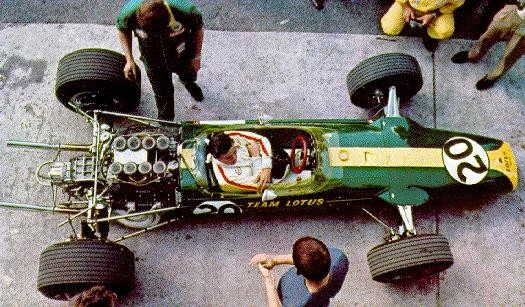
Photo Credit: As published on http://www.jsolana.com.mx/reportaje/lotus.html

Tuesday, 30 August 2011

Paddock Club

One of the features at Marussia Virgin Racing was life at the blunt end of the pit lane. Sometimes you'd be the first pit to be reached in the pit lane, like at Silverstone, and others you'd be the last, as in Hungary. This usually depended on the position of the important facilities, such as the podium and media centre but it did also mean that quite often there was a more or less empty garage next to us, usually occupied by a group of marshals.

Nowadays, one comes to think of the Paddock Club as referring to the well-heeled guests and sponsors of the teams, receiving fantastic hospitality and exclusive access to drivers and garages in return for a four-figure sum. At MVR we were occasionally able to give away Friday tickets to lucky fans, but sadly that's the exception rather than the rule.

But I prefer to think of the volunteers that give up their time to allow any motorsport event to take place as the real Paddock Club, so here's a shot of the glamorous conditions just one storey down from its more opulent namesake. Trestle tables and cool-boxes are the name of the day, rather than linen and champagne buckets, but I suspect the guys are perfectly happy with their lot. You don't get to be a marshal at an F1 race without giving up time to go through a great deal of training, and there's usually a lot of officiating at club events (and in the UK that means putting up with very cold conditions) before moving up to the big stuff.

To all the marshals out there, thanks. Our sport couldn't function without you.

Wednesday, 24 August 2011

Time To Go Home

I know we are all looking forward to the Belgian Grand Prix, but when it's over, and especially if it's raining, spare a thought for the folk who have to put everything away. Packing starts while the race is still on, although care is taken to make sure it doesn't look like that. But that's when the trucks start to reveal their inner secrets.

Hospitality gets packed away too, so it's not uncommon to see trucks loaded with trees and bushes, or the occasional semi-surreal site of a fruit bowl co-existing with engineering equipment. Of course, the engineers and mechanics have fruit provided for them too (although the chocolate generally disappears first) but it's not displayed quite as nicely.

The motorhomes are not that easy to dismantle, although some teams have an easier job than others. You can generally reckon that the relatively simple HRT motorhome will be one of the first to be ready to drive home. Red Bull and McLaren, which require in excess of 40 trucks between them to transport the Energy Station and Communication Centre, will take a little longer.

This is the Williams motorhome, which for some inexplicable reason, starts to blast out loud rock music once it is no longer required for media functions.

Finally, there's the cars themselves. Sometimes they seem to sit around in Parc Ferme forever, before being released by the FIA. It's not uncommon to wait a couple of hours before they can be returned to the garage when they can then be cleaned, dismantled and packed for travelling.

As you can see, it starts to get dark fairly quickly, so all of the workers wear Hi-Vis to make sure that the fork lift drivers can see them, as everything still happens at F1 pace - nobody wants to stay longer than they have to!

Tuesday, 23 August 2011

Driver pics - Hungary

First of all, an apology for the quality of these pics. I probably should have taken a decent camera with me, but when you're in a working environment you kind of feel guilty about snapping pics of the stars in a quiet moment. So I never used flash, and the rooms or garages where the drivers congregate are always starkly lit, making photography from any angle tricky. That's especially true when trying to be a bit subtle, and when using an iPhone.
But still, not many people get to see drivers just before they get on the truck to do their parade lap, so I offer these as a sample. Let me know if the series is worth continuing. 

I've opted for a black and white look on these, as I love the shots from the sixties of drivers in the paddock. I always found it interesting to see who talks to whom, and in what language. You'll notice that Timo isn't in any of these pics, he was over on the left of the garage chatting, as he often does, to Jarno. Who's your favourite driver talking to?