The subject of tyre testing will remain a hot topic until the international tribunal on June 20, at which point there will either be a big fuss, or a big fuss. Mercedes will either be chastised, possibly even severely punished, or they will be cleared. And whichever way the decision goes, some people in the paddock are bound to be upset, unless the tribunal manages to pull off a masterpiece of diplomacy.
And even then, Luca di Montezemolo is likely to be miffed and rant a lot, because that's what he does.
But nobody is really talking much about the Ferrari test, run between the Bahrain and Spanish GPs.
Ah, but it was a 2011 car, run by Corse Clienti, so that's ok, goes the standard response. Mercedes used a current car and that's not allowed in the Sporting regulations.
So here's my question. What defines a 2011, or a 2013 car?
The regulations certainly define what's legal, but we all know that the regulations haven't changed that much in three years. Probably the biggest change is in the exhaust-blown diffuser area. DRS was around in 2011, and the new noses make a bit of a difference, but not much I'd guess.
The monocoque will have been optimized, but not to a massive degree, we are not talking about something that would fundamentally change the way the tyres are used.
I've seen a floor of an F1 car put together in a garage at Barcelona. It involves bonding some carbon fibre, grinding some edges, and maybe cutting some slots, maybe some trimming work. It's not beyond the imagination to think that a 2013 floor could be fitted to a 2011 car. Especially if you've run out of 2011 spares.
Of course you'd need to use the correct exhausts to match the floor, but they mount direct to the engine, the design of which has been frozen for the last, what, six years? So you could get them to fit too, easily. Especially if all your 2011 exhausts had been turned into rather elegant hatstands or lamps.
Bodywork? At worst there is tank tape, or duct tape if you prefer. I've seen whole corners of a car repaired with tape at a race meeting. To think that the most gifted mechanics in the world couldn't fake a set of 2013 bodywork with tape is, well, unthinkable.
And the easiest aspect of all? The electronics. The ECU is standard, and I don't believe the hardware has changed since 2010. Putting the latest software on it would be as easy as updating from iOS5 to iOS 6. Easier probably. And remember, there is no scrutineering at a test.
Here is my second question. As Pirelli already own a 2010 spec Renault (aka Lotus) why didn't they either upgrade that to 2011 spec, or buy/lease/rent a 2011 spec car from Lotus, or even HRT?
I believe that the reason that Pirelli needed to test the current tyres was to understand the current implementation of exhaust blowing. To understand how the tyres deal with the varying loads generated.
Presumably, that's why they haven't purchased a 2011 Sauber, Caterham or Marussia. Teams that would presumably be happy to get some extra income from a sale. Those cars just wouldn't give Pirelli the information the engineers need.
I'm certainly not saying that what I described above actually happened. But it wouldn't be inconceivable that it could be done.
Rather like Trigger's Broom - "I've had this broom for 20 years, it's had five new handles and six new heads, but I wouldn't be parted from it..."
I can't help wondering if Theseus's paradox will be referred to on June 20.
Thursday, 13 June 2013

Wednesday, 12 June 2013
Porsche at Le Mans

I always used to listen to radio reports from La Sarthe; tales of Ferrari v Porsche, or Ferrari v Ford. But in the 70s and 80s it was Porsche that dominated: 935s and 936s (Martini livery, not the Jules after-shave version please) and the all-conquering 956 and its not-quite-so-pretty, longer wheelbase (to protect the drivers' legs) sister, the 962.
It's all too easy to forget that F1 drivers used to drive cars other than F1 (don't forget that Jim Clark actually won the BTCC championship in 1964, his two F1 championships either side of that, and there were sports car and Indy activities too).
Two races spring to mind, the Brands Hatch 1000km, 1970 and the 1000km at Spa, 1985. The first has a happy ending, Pedro Rodriguez driving through the pouring rain to win by 5 laps despite being black flagged early in the race. The second was where Stefan Bellof (who was closing on Ayrton Senna in the infamous 1984 Monaco race) lost his life, the result of trying to pass Jacky Ickx at Eau Rouge. Fortunately, safety has improved since then, although we have again been reminded of the fragility of human life, with Mark Robinson tragically being crushed by a mobile crane in Canada. We can never under-estimate the work that marshalls do, and the risks they take.
Porsche belong at Le Mans, and it will be good to have them back. I'm not sure what my favourite Porsche Le Mans car would be, I've seen 956s and 962s there (and oodles of GT2/3 911s but that doesn't count) and also the GT1, but the favourites for most people are likely to be the 917s, probably in Gulf colours.
In choosing my favourite version, I'll admit a preference for the Langheck (long tail) version, but given that my all time favourite from Stuttgart would be the 908/3 in Targa Florio form (see my profile on Twitter if you don't know what that looks like) then I should really opt for the 908 LH. As you can see below, it's not too different visually to the 917s above.

Tuesday, 11 June 2013
Red Bull and Tyres

Unsafe the tyres are most certainly not. We've had no spontaneous punctures (the only failures have been where nasty sharp carbon fibre shards have been involved) and although there have been a couple of delaminations at Mercedes, the carcass has remained solid and the car has continued to be driveable.
Well, I say I don't understand the attacks - but of course I do. I just don't want to.
Most F1 fans (I think) tend to believe what they read in the papers, hear on the radio and see on TV. But the problem is always the sub-text. What people are not saying. And what Red Bull are not saying is that they believe their car is so much better than all the other cars, which they could prove by running off into the distance if only they could get some consistent rubber to race on.
They understand (of course) that the tyres were designed to be unpredictable and degrade in order to make the racing more interesting. But no team wants interesting racing, they want to win. Winning an interesting race is great, obviously, but they would never choose interesting over winning. So their campaign is aimed at getting back closer to 2012 rubber, where their aero package would work even better than it does with 2013 tyres.
That would probably be seen as unfair on the teams like Lotus (née Toleman) who designed their cars to the published specifications. But, as lobbying for change to the rules is not itself outside the rules, it's considered fair game. Compulsory even.
It's pretty well known that F1 teams find it impossible to be unanimous about pretty much anything. Which is why there is still no (Concorde) agreement to define the commercial agreement between the teams and FOM. It is amazing that the teams ever agreed on the name Concorde. There used to be a story that at one of the meetings at Heathrow airport, the only agreement reached just before the lunch break was what sandwiches should be served for lunch...
When I've talked to F1 engineers and team principals, the key message seems to be that they don't really mind what the regulations are, as long as they are the same for everyone. Of course, if you can get the regulations that you believe would benefit you (eg a budget cap would benefit a less well-off team, unlimited testing is more desirable for teams with large budgets) then all well and good.
The FIA is there to define the regulations, which they've done. And they should remain static for the year. I personally would like to see Pirelli give three sets of each of the four dry compounds to the teams for each car. And then let the teams use them how they like over the weekend. Regardless of the circuit.
The strategy options would multiply significantly, introducing more doubt, and teams would have to push more. If they think the Mediums are wearing too quickly during free practice, they could qualify on Softs and then switch to Hards and run without a stop in the race. Or throw on a set of Super-Softs for the last three laps if they get a puncture.
Of course, there would still be something we'd find to complain about, as would the teams. But I still think it would be fun.
Monday, 10 June 2013
Racing Contact
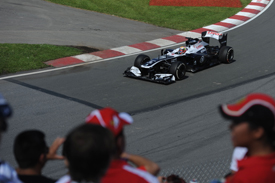
Perhaps this explains a lot about the way he drives. F1, BTCC even, are supposed to be contact-less sports. Which by definition, excludes "normal contact". As it happens, I did think he was unlucky, as the contact with Sutil was a result of apparent misjudgment, rather than a blatant attack or badly mistimed lunge. But frankly, he still deserves the penalty just for thinking that he should be allowed to contact other cars.
The recipient of his challenge, Adrian Sutil, also needs to think a bit more. And while I disagree with the current blue flag regulations (I think being able to pass back markers should be part of a driver's armoury) Sutil does need to understand and respect the rules that currently exist. It's pretty clear that a driver needs to give way within two to three marshalls' posts, or risk a penalty. Not a complete lap as he is reported as saying. That's probably because he is not used to being a lap down on the leaders, but that is no excuse. I bet recordings of adrian ranting that a Caterham or Marussia won't let him past straight away aren't that tricky to find.
Finally, in the drivers that need to be a bit more careful league, Guido van der Garde. While he claims that Webber came from too far back to pass going into the corner, for me he is missing that spatial awareness that drivers like Alonso, Hamilton and Webber show when racing each other closely. How can he not have noticed that Mark was on the inside? It's simply not good enough to look in your mirrors and then drive round the corner without looking again. Drivers must know where the other cars are, or contact is inevitable. His penalty for the Sauber incident, though, is laughable. A five place grid penalty - for the man that almost always qualifies 21st or 22nd. It makes no sense.
Monday, 22 April 2013
Save the Ring

I saw a sticker on the back of a car in Zürich this morning: "Save the Ring". I'm guessing that unlike most residents of the city, I knew what it meant.
www.savethering.org is a commendable venture, aiming to protect the world's greatest stretch of tarmac from the hands of evil businessmen and councillors.
But I can't help thinking that the campaign isn't really necessary - although it does provide a reason for ring-lovers (I hope that's not a euphemism for anything) a chance to meet up without having to spend their hard-earned €uros on laps of the track. Not that they'd mind that, it's their favourite hobby.

I love the Nürburgring, or more particularly the Nordschleife - a 22km long one-way toll road (as it's officially described) running through beautiful German countryside. I've driven round it in quite a few different cars, and the only reason I haven't scared myself silly is that I'm too much in awe of it. During the first lap I drove, I passed the scenes of two accidents. In each case, a motorcyclist had over-estimated their talent and left the road. Motorcyclists do not combine well with Armco barriers, and an ambulance is usually urgently required on the scene.
The Nürburgring is perceived as being under threat because of the huge financial debts associated with it after the "Nüro-disney" theme park that was built there, but, to be honest, I'm more concerned about Brands Hatch (especially the GP circuit) or Oulton Park. Monza even. These are the sort of circuits that suffer a real threat; wealthy residents have moved close to the tracks long after the circuit was built, and don't like the noise of racing exhausts at peak barbeque time on a sunny Sunday afternoon. Political pressure ensues.
But the Nürburgring doesn't suffer from that. The Eifel forest is an empty area with only a few villages, most of whom either make their living from timber or businesses that generate revenue from people driving round the Nordschleife with great rapidity.
It makes no sense to close the Nordschleife. It is perfectly possible to run a commercial venture that covers the operating costs with income from car manufacturers, race teams and people like me, who just enjoy the opportunity to drive round corners at speeds higher than Her Majesty's Constabulary deem prudent.
The theme park will never recoup it's investment, and it's unclear whether the losers will be local taxpayers, Germans in general, or the people that fund the European Union (there may be a subtle difference between those last two but I doubt it). But nobody will decide to destroy the circuit.
At some stage, someone will decide to separate the toxic part of the business (the leisure park) from the profitable part of the business (the racetracks) and all will be well.
Not ideal perhaps, but well. There may be hikes in charges for using the Nordschleife, but that's appropriate in a commercial business aimed at providing the best return to its shareholders (which should be all businesses). A competent management will balance supply and demand and if they don't, the business will fail, and someone else will buy it and aim to maximise their investment.
In many cases, dying businesses are bought in order to strip them of valuable assets. In this case, the main asset is a racetrack, built on land that isn't really useful for either industry or housing. So it will continue to make sense to run it as a circuit, it's just a question of determining the price that makes it viable. Obviously, users of any service like that service to be as cheap as possible, but that is determined by competition. And, as there is only one Nürburgring, there is no equivalent, no competition.So the customers will continue to pay the market price to use it.
So do we need to Save the Ring? I'd like to think that it will save itself. Just as long as we love it enough.
Revamping
You may have noticed that I'm having a bash at revamping/rebuilding/resurrecting my blog.
I'm trying to get together some pieces that have been publisghed elsewhere, and have them pretty much in one place. Hopefully that won't frustrate any readers that see a five-year-old post suddenly appear in their reader. Apologies if it does.
And it'll take me a while I'm afraid. I keep reading all the stuff that I wrote ages ago, and have already forgotten...
Sunday, 21 April 2013
Bahrain
Two things struck me both about today’s race, and the background to it.
Firstly, DRS is currently too significant. Yes there was some great passing, but some of it was just too easy. My current theory is that DRS shouldn’t affect top speed, just allow the car behind to gain the speed it would have had if it hadn’t been running in dirty air. It can’t be impossible to develop an algorithm to allow that. I’m available if the FIA is interested.
Secondly, what’s all this nonsense about letting Bahrain be the first race again (as it was in 2010, the only year that I’ve been there)? They should be happy that the race hasn’t been cancelled either this year or last, and they don’t even fill the low capacity grandstands. So why would anyone want them to have the honour (that currently Australia rightly has) of having the first race? The reason would, of course, be money; money that will not be staying in motorsport.
Subscribe to:
Posts (Atom)